
The words either and neither look like a matching set—and they are. They often talk about two choices. But they can play different grammar roles (determiner, pronoun, conjunction, adverb), which is why learners sometimes feel stuck on either vs neither.
This confusion becomes even bigger in everyday conversation, where you may hear short replies like “Me neither.” And then you may wonder: “Do I use ‘me either’ or ‘me neither’?“
A helpful way to organize everything is to remember a simple idea:
- Either = one choice is possible / it doesn’t matter which one (for two options), OR “also” in negative sentences.
- Neither = not the first option and not the second option (a negative about two).
Once you see the main meanings, the most common patterns—either and neither in real sentences—start to feel much more predictable.
The core meanings: choice, negative choice, and “not either.”

If you want the difference between either and neither in one sentence, it’s this:
Either points to one of two (or each of two, depending on structure), while neither points to not one and not the other.
Either as a “two-choice” word
Either can be a determiner (before a noun), a pronoun (standing alone), an adverb, or a conjunction.
When either is a determiner for two choices, it normally comes before a singular countable noun:
- “Either restaurant will be okay.”
If you want to use either before something like the / these / those / my with a plural noun, you typically need either of:
- “Either of the children can come.”
Another common use: either … side means “both sides / each side”:
- “There were shops on either side of the street.”
This is one reason learners sometimes pause and think, “Wait—does either mean one or both?” The answer depends on the structure, and in phrases like either side, it often means “each.”
Neither as “not either.”
Neither also has multiple roles.
As a determiner, neither lets you make one negative statement about two things at the same time, and it goes before a singular countable noun:
- “Neither parent came.”
With neither of, you can refer to two people/things using a pronoun or a plural noun phrase:
- “Neither of us went.”
So, if you’re deciding either or neither, think of it like this:
- Either one is fine / choose one
- Neither zero is fine / choose none
The most useful sentence patterns
Learners usually meet either and neither in three “high-frequency” patterns: either…or, neither…nor, and not…either. These patterns cover most everyday situations, from ordering food to writing emails.
Either…or: choosing between options
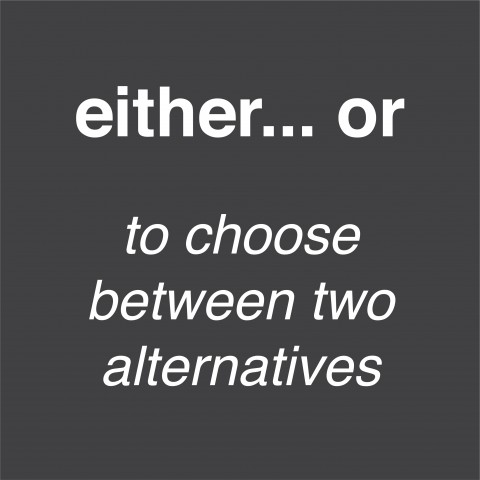
Use either…or to connect two alternatives:
- “Either we go by train, or we rent a car.”
This structure is the classic roadmap for decisions: option A or option B. In general, if you are offering/choosing between two possibilities, you should use either…or.
Neither…nor: rejecting both options
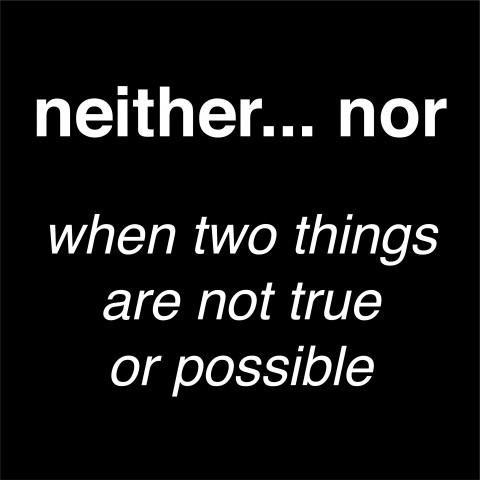
Use neither…nor to connect two negative alternatives:
- “Neither Brian nor his wife mentioned anything.”
There is also a less formal alternative: instead of “neither…nor,” you can use “and … not … either”:
So, a practical “when to use either vs neither” tip is:
- If you want to sound neutral about two options, use either…or.
- If you want to make a negative statement about two options, use “neither…nor” (or the less formal “and…not…either”).
Not…either: “also” in negative sentences
In positive sentences, English often uses “too” or “also.” But in negative sentences, either can work like “also,” placed after a negative verb:
- “She doesn’t like eggs, and she doesn’t like fish either.”
This is one of the most important points in the meaning of either and neither: either is not only about choices—it is also a common “negative agreement” word inside a sentence.
“Me either” or “Me neither”: what sounds natural, and what’s standard
The standard replies
If someone makes a positive statement and you agree, the standard short reply is:
- “Me too.”
If someone makes a negative statement and you agree, two standard options are:
- “Neither do I.” (more complete, more explicitly grammatical)
- “Me neither.” (very common in conversation as an informal, shortened reply)
Neither can appear on its own in replies when two options have already been mentioned (for example, “Tea or coffee?” “Neither, thanks.”). This supports the idea that neither works naturally as a standalone reply in spoken English.
So is “Me either” wrong?
“Me either” exists in casual speech, but it is nonstandard compared with “Me neither.” While both are used to agree with a negative statement, “me either” is considered ungrammatical. At the same time, “me too” is the grammatical reply to a positive statement.
This is why the safest advice for ESL students is:
If you’re writing formally (school, work, tests), prefer:
- “Neither do I.”
- “Me neither.”
If you hear “Me either” in casual conversation, recognize what it means (agreement with a negative), but don’t make it your default in careful writing.
So when someone asks, “Is it me either or me neither, you can answer:
- In careful, standard English: “Me neither.”
And if you also wonder if it’s “me neither” or “me either,” the same guidance applies: “Me neither” is the safer choice for learners and formal contexts.
Common mistakes (and quick fixes)
Even advanced learners make predictable mistakes with either and neither’s meaning, mainly because negation behaves differently across languages.

Double negatives: “I don’t like neither”
In standard English, “I don’t like neither” is usually treated as a double negative and is not the normal way to express the meaning. Instead, use the phrase “I don’t like either.”
So if you’re thinking about when to use either or neither in negative sentences, remember:
Put the negative in the verb (“don’t / isn’t / can’t”), then use either later: “I don’t like it either.”
Mixing patterns: “Me neither do I”
Avoid combining two different reply structures in one sentence. “Neither” can stand alone (“Neither, thanks”), and traditional full agreement uses inversion (“Neither do I”). Pick one form at a time.
Verb agreement with “either/neither of”
Learners also ask whether “Neither of them is” or “Neither of them are” is correct. In formal styles, “neither of” as a subject typically takes a singular verb, whereas in informal speech, plural verbs are common.
By strict grammar rules, neither is singular and takes a singular verb. Still, plural verbs are common in informal speech when “neither” is followed by “of.”
If you’re preparing for tests or professional writing, the safe default is:
- “Neither of them is …”
Practice and takeaway rules you can actually use
You don’t need to memorize every label (determiner/pronoun/adverb) to speak well, but you do need reliable “go-to” rules. Here are three that cover most situations (and keep the either and neither difference clear).
If you’re choosing between two options:
- Use either…or: “Either A or B.”
If you’re rejecting both options:
- Use neither…nor: “Neither A nor B.”
If you’re agreeing with a negative statement:
- In standard English, prefer “Me neither” or “Neither do I.”
Try these quick fills (no trick questions). Choose either or neither:
A: “Do you want tea or coffee?”
B: “_________, thanks.”
A: “Which day works for you—Monday or Tuesday?”
B: “_________ is fine.”
A: “I didn’t enjoy the movie.”
B: “Me _________.” (Most standard choice.)
Conclusion
The difference between neither and either is simple at the center: either points to a choice (or works like “also” in negative sentences), while neither points to “not this and not that.”
And for the question that brings many learners here—me either vs me neither—the safest answer is: in careful, standard English, prefer “Me neither” (or the full form “Neither do I”), especially in writing and tests.