You can speak and write in English, but does your writing feel… stuck? Maybe your sentences are a bit repetitive, your ideas don’t quite connect, or you keep making the same grammar mistakes. If you want practical strategies to make your B1-level writing clearer and more professional, you’re in the right place.
We’ll take one weak paragraph and fix it together, step by step. You’ll see exactly how each technique works and get a clear model you can use for your own writing.
Table of Contents
Start Here: One Weak Paragraph, Six Fixes

Let’s start with a realistic B1-level draft. Imagine you need to email a company to ask about a seminar. Your first draft might look something like this:
Before:
Subject: Seminar
Hello. I am writing about your seminar. I saw an advertisement. The advertisement say it is next month. I am interested. I need more information. What is the seminar about? When will it take place? Is it for business people? My company wants me to improve my skills. I am interested in this. Also I want to know about expenses. How much does it cost. Is there a discount for groups. I want to know more information before I decide. Thank you.
This message gets the point across, but it has a few common problems:
- Organization: The ideas are scattered. Questions about the seminar’s topic are mixed with questions about cost.
- Sentence Variety: Almost every sentence is short and starts with “I” or “The.”
- Vague Words: The words seminar, interested, and information are repeated a lot.
- Grammar & Punctuation: There are a few mistakes with verbs and punctuation that make it less professional.
- Clarity: Key details are missing, so the reader has to guess what you mean.
Over the next six steps, we’ll fix this paragraph together. By the end, you’ll have a clear, effective email and six powerful techniques to improve your own English writing.
A quick note: We’re using an email as our working example because it’s a common, practical task, but these same six techniques apply to any kind of writing—essays, text messages, reports, or forum posts. Wherever you write in English, the same fixes will make your writing clearer.
Fix #1—Organize Your Ideas So They Flow
Good writing is organized writing. Before you worry about grammar or vocabulary, make sure your ideas are in a logical order. Clear organization is one of the most important factors in writing that actually communicates.
Start with your main purpose, then arrange your supporting details logically. A simple structure for an email like our example is:
- Opening: State your reason for writing.
- Body Paragraph 1: Ask your first group of related questions (e.g., about the content).
- Body Paragraph 2: Ask your second group of related questions (e.g., about cost and dates).
- Closing: Thank the reader and say what you want to happen next.
Use simple linking words to connect your ideas. Words like first, also, but, because, and so act like signposts for your reader, guiding them from one point to the next.
Let’s reorder the ideas from our sample paragraph.
Before (Disorganized):
I need more information. What is the seminar about? When will it take place? … My company wants me to improve my skills. … Also I want to know about expenses.
After (Organized):
I am writing because I am interested in your seminar and need more information. My company wants me to improve my skills, so this is important. First, what is the seminar about, and is it for business people? Also, when will it take place, and how much does it cost? Is there a discount for groups?
See the difference? Just by grouping related ideas, the message becomes much easier to follow.
Fix #2—Vary Your Sentences So Your Writing Doesn’t Sound Choppy
Does your writing sound like a long list? I did this. I saw that. I want this. This happens when all your sentences have the same simple structure. Learning to mix up your sentence patterns is what turns a list of facts into real writing.
Here are two easy ways to create more sentence variety:
- Combine short sentences. Connect related ideas using words like and, but, so, and because. Instead of two short sentences, you get one longer, more fluid sentence.
- Vary your sentence openings. Don’t start every sentence with “I” or “The.” You can start with a connecting word (Also, Because), a prepositional phrase (Regarding the cost, In the advertisement), or rearrange the words.
Let’s apply this to our paragraph, which is already better organized.
Before (Choppy Sentences):
I am writing about your seminar. I saw an advertisement. I am interested. I need more information. My company wants me to improve my skills.
After (Varied Sentences):
I am writing about your seminar, which I saw in an advertisement. Because my company wants me to improve my skills, I am interested and would like more information.
This version flows more naturally. It mixes shorter and longer sentences, making it more engaging for the reader. This is what separates choppy writing from professional writing.
Fix #3—Choose Precise Words Instead of Repeating Vague Ones
Do you find yourself using the same words over and over, like good, thing, nice, or interesting? These words are okay, but they are often too vague. They don’t give the reader specific information. To make your writing stronger, replace vague words with more precise ones.
This isn’t about finding a complicated word in the thesaurus. It’s about choosing the word that says exactly what you mean.
Save This: Vague-to-Precise Vocabulary Reference
Vague Word/PhraseMore Precise Alternativea good ideaa useful idea, a creative ideaa good resulta successful result, a positive resultan interesting seminara helpful seminar, a technical seminarmore _information_more details, _specifics_a nice persona friendly person, a generous persona big problema serious problem, a major problemshe _said_she explained, she mentioned, she _announced_we went to the meetingwe attended the meeting, we traveled to the meetingI have a lot of stuff to doI have a lot of tasks to do, I have a lot of _responsibilities_a thing I noticeda detail I noticed, an issue I noticed
In our sample email, the writer repeats interested and information. Let’s choose some better words.
Before (Repetitive):
I am interested. I need more information. … I am interested in this. … I want to know more information before I decide.
After (Precise):
I am writing to request details about your seminar. I am eager to attend. … Could you please provide more specifics before I decide?
A quick tip: Sometimes, repetition is okay! It’s better to repeat a clear word like seminar than to replace it with an unnatural synonym like colloquium. The goal is clarity, not complexity.
Fix #4—Catch Grammar and Punctuation Mistakes That Confuse Readers
At the B1 level, you don’t need perfect grammar, but you do need to be clear. Some small mistakes can confuse your reader or make your writing seem unprofessional. These are the errors that have the biggest impact on clarity.
In our original draft, we had a few issues:
- “The advertisement say…” should be “The advertisement says…” (Subject-verb agreement)
- “How much does it cost.” should be “How much does it cost?” (Punctuation)
Save This: Personal Grammar Checklist
- Subject-Verb Agreement: Does the verb match the subject? (He goes, not He go.)
- Verb Tense: Are your tenses consistent? (Don’t switch between past and present without a reason.)
- Articles: Did you use a, an, and the correctly?
- Punctuation: Does every sentence end with appropriate punctuation? Does every question end with a question mark (
?)? Are you using commas correctly? Be careful with contractions and possessives, like it’s (“it is”) versus its (belonging to it).- Prepositions: Did you choose the right preposition? (arrive at the office, not arrive to the office; interested in, not interested on.)
- Run-on Sentences: Are you joining too many ideas together without a connecting word or proper punctuation? Break long strings of ideas into separate sentences.
- Comma Splices: Are you joining two complete sentences with only a comma? (I saw the ad, I am interested is incorrect. Use a period, a semicolon, or a connecting word like and or so instead.)
Focusing on these few areas will dramatically improve the quality of your writing.
Fix #5—Make It Clear: Would a Stranger Understand This?
When you write something, you have all the background information in your head. Your reader doesn’t. A great way to check for clarity is to read your writing as if you are a stranger. Would this person understand your message without asking any questions?
This is one of the most effective ways to check your writing for clarity. Look for two things:
- Unclear references: Words like it, this, that, and they can be confusing if the reader doesn’t know what they refer to. In our original email, the line “The advertisement say it is next month” is a little unclear. What is next month? The seminar. It’s better to be specific.
- Missing details: Does the reader have all the information they need? The original email says, “I saw an advertisement.” Where? When? Adding a small detail like, “I saw an advertisement on your website” makes the context much clearer.
Let’s fix these two points in our paragraph.
Before (Unclear):
I am writing about your seminar. I saw an advertisement. The advertisement say it is next month.
After (Clear):
I am writing to request more information about the professional communication seminar I saw advertised on your website. The advertisement says the seminar is next month.
The rule is simple: If you think the reader might have to guess what you mean, rewrite the sentence to be more specific.
Fix #6—Proofread in Three Short Passes
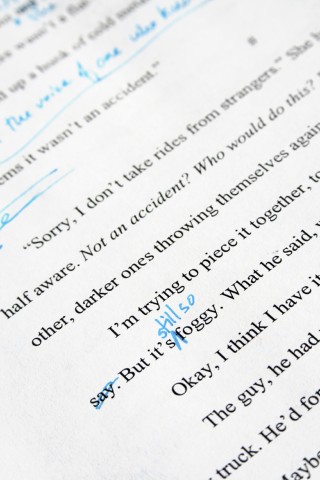
You’ve organized your ideas, varied your sentences, chosen precise words, and checked for grammar and clarity. The final step is proofreading. Don’t try to check for everything at once. It’s much more effective to proofread in three separate, short passes.
- Pass 1: Meaning and Organization. Read through your writing one time just for the message. Do the ideas flow logically? Is your main point clear? Does it make sense?
- Pass 2: Grammar and Sentence Structure. Read it again, this time looking at each sentence. Check for the grammar points on your personal checklist (Fix #4). Do your sentences have a nice variety (Fix #2)?
- Pass 3: Spelling and Punctuation. Finally, read the text one more time, very slowly. Reading it aloud is a fantastic technique for catching small errors, awkward phrases, or missing words. This is also the time to double-check your spelling. If you’d like extra tips for this pass, this guide on How to Improve Your English Spelling Skills? has useful advice.
After applying all six fixes and proofreading, our weak paragraph is transformed into a clear and professional email.
Final Version:
Subject: Inquiry about the Professional Communication Seminar
Dear Sir or Madam,
I am writing to request more information about the professional communication seminar I saw advertised on your website. I am very interested in attending because my company encourages us to develop our skills.
Could you please provide some details about the seminar’s content? For example, what specific topics will be covered, and is it designed for people in technical roles?
I also have a few questions about the logistics. First, when exactly will it take place next month? Also, what is the cost for one person, and do you offer a discount for company groups?
Thank you for your help. I look forward to hearing from you.
Sincerely, [Name]
Compare this to the original. The message is the same, but this version is clearer, easier to read, and much more effective.
Now You Try
Here’s a second weak paragraph, still unfixed. Before you move on, try applying all six fixes yourself. Remember, these techniques work for any type of writing—not just emails—so think of this as practice you can transfer to essays, messages, or reports too.
Your Turn (Unfixed):
Subject: Question
Hello. I am writing about your online course. I saw it on social media. The post say classes start soon. I am interested. I need more information. What topics does it cover? Is it for beginners? My teacher say I should improve my writing. I am interested in this. Also I want to know about the price. How much does it cost. Is there a discount for students. I want to know more before I register.
Use this checklist as you rewrite it:
- Organize — Group the questions about content separately from the questions about price.
- Vary sentences — Combine short sentences and don’t start every one with “I.”
- Precise vocabulary — Replace repeated words like interested and information with more specific alternatives.
- Grammar & punctuation — Fix subject-verb agreement (“the post say” → “the post says”) and add missing question marks.
- Clarity — Add missing details (where did you see the post? what course, specifically?).
- Proofread — Read it three times: once for meaning, once for grammar, once for spelling.
Sample “After” Version:
Subject: Inquiry about the Online Writing Course
Dear Sir or Madam,
I am writing to request more information about the online course I saw advertised on social media. I am very interested in registering because my teacher recommended that I improve my writing skills.
Could you please tell me what topics the course covers, and whether it is suitable for beginners?
I also have a few questions about enrollment. First, when exactly will classes start? Also, what is the price, and is there a discount for students?
Thank you for your help. I look forward to hearing from you.
Sincerely, [Name]
Six Fixes at a Glance
- Organize — Group related ideas so the message flows logically.
- Vary sentences — Combine short sentences and change how they start.
- Precise vocabulary — Swap vague words for specific ones.
- Grammar & punctuation — Check subject-verb agreement, tense, articles, punctuation, prepositions, and sentence boundaries.
- Clarity — Make sure a stranger could understand your writing without guessing.
- Proofread in three passes — Meaning, then grammar, then spelling.
If you’d like more guidance beyond these six fixes, you might also enjoy this lesson on Tips to Improve Your Writing Skills | English Grammar for Beginners as optional additional practice.
Keep practicing these techniques, and for more lessons and resources, be sure to check out EnglishClass101.