The holiday season in the US is exciting, but the shopping can be confusing. That’s because stores are full of signs and special phrases that feel like a secret code. For example, what are you agreeing to when you buy something on “final sale”? And what should you say when the cashier asks, “Paper or plastic?”
This guide to holiday shopping in the US gives you the exact words and phrases you need, from Black Friday to the returns desk after Christmas. You’ll also learn the store names you hear every day, so you can shop with confidence. So let’s decode the language of American holiday shopping together.
Holiday Shopping in the US at a Glance
US holiday shopping in 30 seconds
Big sale days run from Black Friday to the last Saturday before Christmas. Most deals come with conditions, so read the small print. Also, ask for a gift receipt for every present, and keep it until January.
| If you see or hear… | It means… |
|---|---|
| BOGO 50% off | Buy one, then get the second one at half price. |
| While supplies last | When the items run out, the deal ends. |
| Final sale | So you usually can’t return or exchange it. |
| Would you like a gift receipt? | A receipt without the price, so the person can return the gift. |
| Store credit | Money you can spend, but only at that store. |
Table of Contents
- The US Holiday Shopping Calendar
- Sale Signs: What You’re Really Agreeing To
- Shopping Online: From Cart to Checkout
- Checkout English: What the Cashier Will Say
- Gift Words You’ll Hear in December
- Know Your Stores: Where Americans Shop
- Returning or Exchanging a Gift After Christmas
- Refund, Exchange, Store Credit or Final Sale?
- Listen and Repeat: 8 Holiday Shopping Words
- Quiz: Test Yourself
- Holiday Shopping FAQ
- Final Thoughts
1. The US Holiday Shopping Calendar
In the US, the holiday shopping season is a series of named days, and each one also has its own purpose. It’s also huge: the National Retail Federation expects Americans to spend over $1 trillion in November and December. Here are this season’s key dates, so you can plan ahead:
| Day | What it’s for |
|---|---|
| Thanksgiving Thu, Nov 26 | A family holiday that also starts the shopping season. |
| Black Friday Fri, Nov 27 | The biggest day for in-store sales, especially early-morning deals. |
| Small Business Saturday Sat, Nov 28 | Shoppers support small, local stores instead of big chains. |
| Cyber Monday Mon, Nov 30 | The biggest day for online deals, when almost every website has a sale. |
| Giving Tuesday Tue, Dec 1 | A day for donating to charity rather than shopping. |
| Green Monday Mon, Dec 14 | The second Monday of December: big online sales before shipping deadlines. |
| Free Shipping Day Mid-December | Many online stores offer free delivery that arrives before Christmas. |
| Super Saturday (or Panic Saturday) Sat, Dec 19 | The last Saturday before Christmas, when stores are packed. |
| The day after Christmas Sat, Dec 26 | Returns and exchanges begin, while people spend their new gift cards. |
Why is it called Black Friday? In accounting, losing money is being “in the red,” whereas making a profit is being “in the black.” So Black Friday is said to be the day when stores finally move into the black for the year.
Want to know more about the holidays themselves? Then read our guides to Thanksgiving in the United States and Christmas in the United States.
2. Sale Signs: What You’re Really Agreeing To
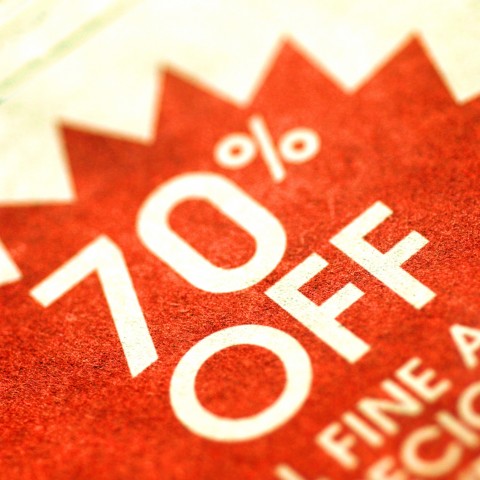
Before you even pick up an item, you’ll see signs everywhere. These phrases are designed to get you excited; however, they often come with conditions. So here’s what they really mean.
BOGO: Buy One, Get One
BOGO (say “BOH-goh”) is short for “buy one, get one.” It’s one of the most common sale types, but the second part of the sign tells you the real deal:
- BOGO free: you pay for one item and then get a second one free.
- BOGO 50% off: you pay full price for one item, and then the second one is half price.
- Of equal or lesser value: this small print means the free or cheaper item must cost the same as, or less than, the one you pay for.
Doorbuster and While Supplies Last
A doorbuster is a deal so good that it makes people rush through the doors when the store opens. These deals usually come in small quantities, and they’re also often only for a few hours. In other words, it’s first come, first served.
While supplies last works the same way for any sale item: when the store sells out, the deal is over. Also, stores usually won’t give you a rain check on these deals. A rain check is a promise to sell you the item at the sale price later, when it’s back in stock.
Clearance vs. Final Sale
These two are easy to mix up, but the difference matters:
- Clearance means the store wants to sell old stock to make space for new items, so the prices are very low. You can often still return clearance items; however, some stores make them final sale, so check the sign or the receipt.
- Final sale (or all sales final), on the other hand, means you usually can’t return or exchange the item. In short, once you buy it, it’s yours.
Quick check: does this sign have conditions?
| Sign | Watch out for… |
|---|---|
| BOGO 50% Off All Sweaters | Only the second sweater is discounted, since it’s usually the cheaper one. |
| Doorbusters: 6 a.m.–10 a.m. Only | Limited items, and also limited hours. |
| While Supplies Last | The deal ends when the stock runs out, usually with no rain checks. |
| Clearance | Big discounts; returns are often allowed, but check first. |
| All Clearance Items Final Sale | So no returns or exchanges on these items. |
Rule of thumb: when it says final sale, assume you can’t return it.
3. Shopping Online: From Cart to Checkout
Many holiday deals start online, even before Black Friday. So, here are the words you’ll see on every shopping website and app:
| Word | What it means |
|---|---|
| Add to cart | Put an item in your online basket before you pay. |
| Check out / Checkout | Pay for your order. Note that check out is the verb, while checkout is the noun. |
| Promo code / Coupon code | A code you type in, so you get a discount. |
| Free shipping | No delivery cost. It often has a minimum, for example, “free shipping on orders over $35.” |
| In stock / Out of stock | Available / not available right now. |
| Backordered | Sold out for now; the store will send it when more arrive. |
| Order tracking | A page or link that shows where your package is until it arrives. |
| Shipping cutoff | The last day to order if you want your package before Christmas. |
Want to practice? Then check out the lesson Online Shopping: Common Terms.
4. Checkout English: What the Cashier Will Say
You’ve found your items, and now you’re ready to pay. So don’t let the conversation at the register surprise you. These are the most common questions, together with easy answers:
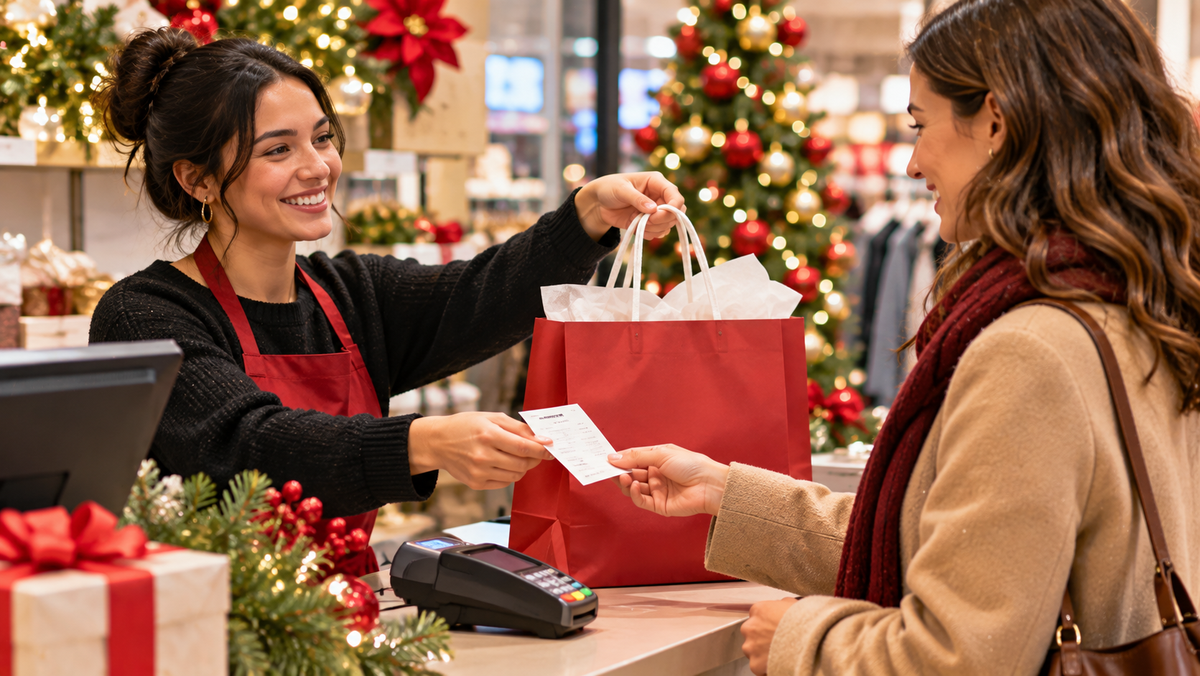
Common Checkout Questions
| The cashier asks… | You can say… |
|---|---|
| “Did you find everything okay?” | “Yes, thanks.” It’s just a friendly greeting, so a short answer is fine. |
| “Do you have a rewards card with us?” or “Can I get your phone number for rewards?” | “No, thanks.” or “Yes, it’s under this number…” |
| “Do you have any coupons?” | “Yes, I have one on my phone.” |
| “Would you like a gift receipt?” | “Yes, please.” Always say yes when it’s a present! |
| “Would you like to round up for charity?” | “Sure.” or “Not today, thanks.” It means adding a few cents to your total, so the extra goes to charity. |
| “Cash or card?” / “Debit or credit?” | “Card, please.” Then tap, insert or swipe it. |
| “Do you need a bag?” or “Paper or plastic?” | “Paper, please.” or “I have my own bag, thanks.” |
| “Would you like your receipt printed or emailed?” | “Printed, please.” |
Good to know: a gift receipt doesn’t show the price, so the person who gets the present can return or exchange it without seeing what you paid. Also, some states and cities charge for bags or ban plastic ones, so you may hear “Do you need a bag?” instead of “Paper or plastic?”
A Checkout Conversation
Finally, here’s how it all sounds together. Note that US price tags don’t include sales tax, so the total is often a little higher than you expect:
At the checkout counter

Want to hear more? Watch Top 15 Must-Know Phrases to Go Shopping in English, and then practice a full conversation in Going Shopping at an American Boutique.
Shop, chat and celebrate in real English
EnglishClass101’s audio and video lessons teach you the English Americans actually use, from the checkout counter to the holiday table. So create your free account and start today.
Start Learning for Free5. Gift Words You’ll Hear in December
December shopping is mostly gift shopping, so these words come up all the time:
- Gift card: a card with money on it for one store. It’s also one of the most popular presents in the US.
- Gift wrap: decorative paper for presents. Also, some stores offer free gift wrapping in December.
- Stocking stuffer: a small, cheap gift that fits in a Christmas stocking, such as candy or socks.
- Secret Santa: a game where each person in a group buys a gift for one other person, usually with a price limit.
- Wish list: a list of things you’d like to get, so friends and family can use it for gift ideas.
6. Know Your Stores: Where Americans Shop
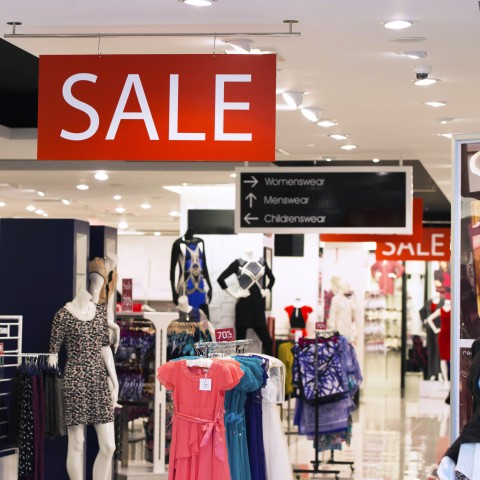
Americans often say a store’s name instead of the type of store, as in “I got it at Target” or “Let’s do a Costco run.” So, here are the store types and names you’ll hear most, together with a useful phrase for each one:
| Store type | What they sell | Useful phrase |
|---|---|---|
| Big-box store Walmart, Target | Almost everything, such as food, clothes and toys | “I’ll do a quick Target run.” |
| Warehouse club Costco, Sam’s Club | Items in bulk (large amounts), but only for members | “Do I need a membership to shop here?” |
| Department store Macy’s, Nordstrom, Kohl’s | Clothes, beauty products and home goods, in different departments | “Which department has sweaters?” |
| Electronics store Best Buy | TVs, laptops, phones and video games | “Can someone help me compare these two TVs?” |
| Off-price store TJ Maxx, Marshalls, Ross, HomeGoods | Brand-name items for less, but the selection changes all the time | “What a great find!” |
| Dollar store Dollar Tree, Dollar General | Cheap basics, snacks and party supplies | “Everything here is so cheap!” |
| Drugstore CVS, Walgreens | Medicine, snacks and also last-minute gifts | “Is the pharmacy still open?” |
| Online store Amazon | Almost anything, delivered to your door soon after you order | “It should arrive in two days.” |
Curious about where Americans find the best prices? Then listen to You Paid What?! The Best Place to Shop in America, or read along with Shopping at the Dollar Store.
7. Returning or Exchanging a Gift After Christmas
After the holidays, you might need to return a gift that isn’t quite right. In that case, take it to the customer service desk and use these simple phrases:
- “I’d like to return this.” This is the most direct way to start, so use it first.
- “Can I exchange it for a different size?” Use this when you like the item but need another size or color.
- “I have a gift receipt.” This tells the clerk that it was a present, so they know your options.
- “Can I get store credit instead?” This works well if you don’t see anything else you want today.
- “Do I need a receipt for this?” Ask this when you don’t have one.
Be ready for a few rules, too. Most stores have a return window (a time limit such as 30 or 90 days), and many extend it into January for holiday purchases. Also, the item usually needs its original tags, and final sale items can’t be returned. With a gift receipt, you usually get an exchange or store credit, because the refund would go back to the person who paid.
At the customer service desk
8. Refund, Exchange, Store Credit or Final Sale?
First of all, knowing exactly what you want makes returns much smoother. However, these four words have very different meanings:
| Word | What you get | Ask for it like this |
|---|---|---|
| Refund | Your money back, which then goes to the card you paid with. | “Can I get a refund?” |
| Exchange | The same item in another size or color, or a different item. Also, you pay or get back any price difference. | “Can I exchange this for a large?” |
| Store credit | A gift card or credit for the item’s value, but only for that store. | “Can I get store credit instead?” |
| Final sale | None of the above, unless the item is broken or faulty. | — |
In short, decide what you want before you get to the counter. Then ask for it clearly:
Can I have a refund? – the most direct way to ask for your money back
9. Listen and Repeat: 8 Holiday Shopping Words
Now, tap each player to hear a native speaker, and then repeat the word out loud. These eight words come up in almost every shopping trip, so they’re worth learning:
sale
lower prices, but only for a short time
discount
money taken off the usual price
coupon
a ticket or code for a discount
receipt
the paper or email that proves you paid
return
to take an item back to the store
exchange
to swap an item for another one
refund
money paid back to you
department store
a big store with many sections
🔒
Save these words to your flashcards
Get the free Talking About Going Shopping word list with native audio and images, then review it for a few minutes a day before your next shopping trip.
Get the Free Word List10. Quiz: Test Yourself
Now check what you’ve learned. Then tap an answer to see if you’re right.
Sale Signs and Checkout
Questions 1–3
1. A sign says “BOGO 50% off.” What do you get?
A. Both items at half price
✗ Not quite. Actually, only the second item is half price.
B. The second item at half price
✓ Correct! You pay full price for the first item, and then the second one is 50% off.
C. A free second item
✗ Not quite. That would be “BOGO free,” though.
2. What can you usually NOT do with a final sale item?
A. Return it
✓ Correct! Final sale means no returns or exchanges, unless the item is faulty.
B. Pay by card
✗ Not quite. Actually, you can pay for final sale items any way you like.
C. Use a coupon
✗ Not quite. Coupons may still work, so check the coupon’s small print.
3. The cashier asks, “Would you like a gift receipt?” What does it show?
A. The price
✗ Not quite. Actually, a gift receipt hides the price.
B. Everything except the price
✓ Correct! So the person can return the gift without seeing what you paid.
C. Your credit card number
✗ Not quite. Also, no receipt shows your full card number.
Returns and Shopping Days
Questions 4–5
4. You want your money back. What do you say?
A. “Can I get store credit?”
✗ Not quite. Store credit, however, can only be spent at that store.
B. “Can I exchange this?”
✗ Not quite. An exchange gives you another item, not money.
C. “Can I get a refund?”
✓ Correct! That’s because a refund means you get your money back.
5. Which day is famous for online deals?
A. Small Business Saturday
✗ Not quite. Instead, that day is about supporting local shops.
B. Cyber Monday
✓ Correct! Indeed, Cyber Monday is the biggest day for online sales.
C. Super Saturday
✗ Not quite. Super Saturday is the last big day for in-store shopping.
11. Holiday Shopping FAQ
What does BOGO mean?
BOGO stands for “buy one, get one.” For example, “BOGO free” means you get a second item for free, while “BOGO 50% off” means the second item is half price.
Why is it called Black Friday?
In accounting, “in the black” means making a profit. As a result, the day after Thanksgiving became known as the day stores start making money for the year.
What is a gift receipt?
A gift receipt is a receipt without the price. You give it with a present, so the person can return or exchange the gift easily.
Can you return clearance items in the US?
Often, yes, under the store’s normal return policy. However, some stores mark clearance items as final sale, so always check the sign or your receipt.
When is the best time for holiday shopping in the US?
Generally, the biggest deals come between Black Friday and Cyber Monday. Then, for online orders, try to buy before the shipping cutoff in mid-December, so your gifts arrive in time.
Final Thoughts
So, with these phrases and tips, you’re ready for holiday shopping in the US. You can now read sale signs, talk to the cashier, shop online and even return a gift like a pro. Before you head to the stores, check yourself:
Can you do this now?
✓Explain what “BOGO 50% off, while supplies last” really means?
✓Say what Black Friday, Cyber Monday and Small Business Saturday are for?
✓Answer “Would you like a gift receipt?” and “Do you need a bag?”
✓Say “I’d like to return this” and “Can I get store credit instead?”
✓Choose between a refund, an exchange and store credit?
✓Name a big-box store, a warehouse club and a department store?

Finally, if you want more practice, watch Top 10 Phrasal Verbs for Shopping in English, and then study them step by step in the lesson 10 Phrasal Verbs for Shopping.
Practice every shopping word with native audio
Save the free Talking About Going Shopping list to your flashcards, then keep going with hundreds of EnglishClass101 lessons by native teachers.
Get the Free ListWhat’s the best deal you’ve ever found? Then tell us in the comments. Happy shopping!